The Words Are Doing the Work
How phrasing turns people into problems — and policies into “common sense.”

In my first essay, “The ‘Yes, But…’ Majority,” I wrote about the persuadable middle — the people who support non-discrimination in hiring and housing, and then hesitate when the conversation shifts to kids, schools, bathrooms, and sports.
The chart with poll results in that article (added below as a reminder) matters because it reveals something a lot of folks have a hard time reconciling: many people are trying to hold fairness and fear at the same time. But there’s another truth we have to name if we want to understand what we’re looking at. The poll is doing persuasion before anyone answers a single question.
And as someone with a degree in journalism and a career spent in marketing and advertising, I’ve been trained in two skills that can feel like opposites: how to write without bias and how to use language to evoke emotion and get a response. That background makes it hard for me to read polling language as “neutral,” especially on an issue that has been intentionally turned into a moral panic. Because wording doesn’t merely describe reality. It creates it.
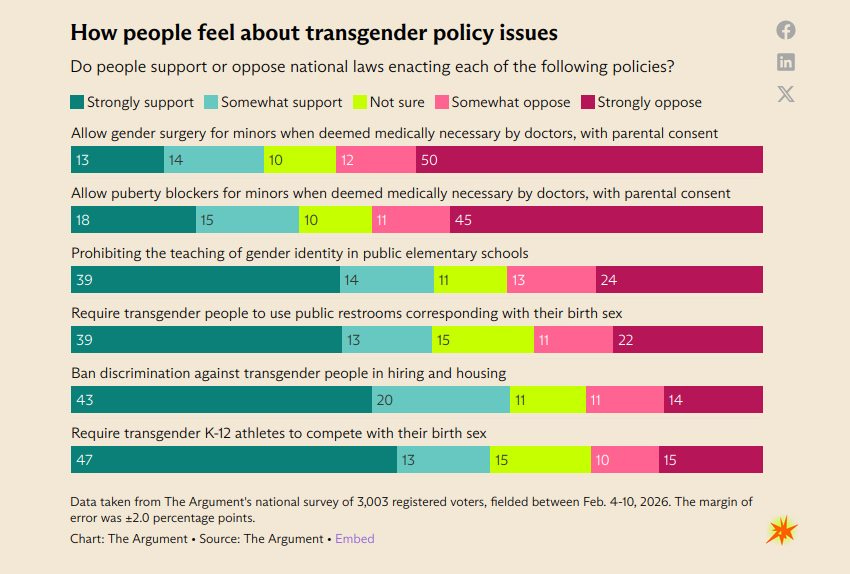
The premise comes first: the poll tells you these are “laws” we should be debating
Before the poll even gets to specific policy statements, it establishes a powerful frame. It asks something like:
“Do you support or oppose national laws enacting these policies?”
That phrasing does two things at once:
It signals that these are legitimate policy problems the nation should be solving with laws.
It quietly removes a perfectly reasonable response many people might otherwise have:
“Wait — why is this a matter for national law at all? Bathrooms and healthcare are private matters. School conversations are local and contextual. Why are we legislating personal aspects of someone’s life?”
In other words, the frame isn’t: “Should the government be regulating this?”
The frame is: “Which way should the government regulate this?”
And once a question assumes regulation is appropriate, a lot of people stop questioning the appropriateness. They just pick a side within the box they’re handed.
Repetition trains the public to accept the box
This matters even more because the public has been conditioned — through constant repetition — to experience “trans issues” as urgent, omnipresent, and political by default.
Media Matters has documented dramatic bursts on Fox News around trans athletes — like a spike from six segments in September 2024 to at least 47 in October 2024, weeks before the election.
They also found that after Trump signed the “Keeping Men Out of Women’s Sports” executive order, Fox aired at least 424 weekday segments mentioning trans athletes over roughly four months, with the peak week hitting at least 59 segments.
And it isn’t limited to sports: Media Matters found Fox News outstripped CNN and MSNBC in cable coverage of anti-trans executive orders in the first month of Trump’s second term.
This is how you train an audience — not by proving something is true, but by making it feel constant and “obvious.” Then a poll comes along and asks whether we should have national laws about the thing you’ve been told is everywhere — and many people answer from that trained sense of urgency.
The oldest trick in politics: start with a feeling, then call it “common sense”
Look at how the words used in the survey questions frame hot-button issues:
“Minors”
“Elementary schools”
“Prohibit teaching…”
“Require bathrooms…”
“Birth sex”
“Surgery”
“Puberty blockers”
These aren’t neutral words — at least not anymore. They’re emotional triggers designed to activate protective instincts, boundary instincts, and alarm bells. If you lead with a feeling, people will often treat that feeling like evidence, not because they’re bad but because they’re human.
One or two word changes can flip the emotional temperature
Here’s the most important thing I want you to notice: many of these policy statements are written in “restriction language.” The verbs and nouns are chosen to make control feel like safety.
Below are examples of how the same underlying topic can feel very different with one or two changes — because the reader is responding not just to the issue, but to the story the language is telling.
“Prohibit teaching gender identity in public elementary schools”
Original framing: “Prohibit teaching…” This shouts “danger, we must stop it!”
Simple flip: “Allow discussion of gender identity in public elementary schools.”
This normalizes the topic and makes room for context.
Less dramatic change: “Allow teaching about gender identity in public elementary schools.” This is still formal, but removes the alarm word “prohibit”.
More precise version: “Prohibit required curriculum instruction on gender identity for adolescents in public elementary schools.” This version introduces specificity: required curriculum, instruction, and acknowledges that “elementary” can include older kids.
Notice what changes here: the reader has space to ask, “Are we talking about banning a lesson plan or banning a teacher from answering a question? Are we talking about little kids or fifth and sixth graders?” Precision makes panic harder.
“Require bathrooms by birth sex”
Original framing: “Require…” This screams “order, enforcement, and control”.
Simple flip: “Allow people to use bathrooms that match their gender identity.”
This asks the person to consider inclusion rather than policing.
Less different change: “Allow schools and businesses to set inclusive bathroom policies.” This shifts the question from a national mandate to local, practical management.
More precise version: “Provide single-user restroom options where feasible, without restricting transgender people’s access to restrooms.” This centers privacy solutions without targeting a minority.
The same topic is addressed — privacy and shared space — but with wildly different emotional cues of policing vs accommodation.
“Require trans athletes to compete by birth sex”
This is often sold with a single word…fairness. Fairness is real and does deserve a serious conversation. But the question format does something subtle: it shrinks a complex reality into a single emotional image — a threat — and then offers a single solution: restriction.
And it rarely requires the reader to imagine what it means for a student to be singled out, debated, and turned into a controversy instead of a child.
It’s also why the “trans athletes” narrative gets so much oxygen in certain media spaces: it reliably produces a reaction, and it turns nuance into a simple villain/victim story. Let’s look at the language:
Original framing: “Require…” + “birth sex”. This implies that it’s a simple matter of sorting and creates a hard boundary.
Simple flip: “Allow transgender students to participate in sports consistent with their gender identity.” This centers belonging and reminds people that we are talking about young people — students.
Less different change: “Set fair participation guidelines for school sports that protect all students’ opportunities.” This keeps the stated goal of fairness front and center without pre-selecting a target.
More precise version: “Create age-appropriate, sport-specific participation policies for school athletics, developed with medical and athletic experts.” This option acknowledges complexity instead of pretending one rule fits every age and sport.
“Puberty blockers” and “gender surgery for minors”
If there’s one place wording almost guarantees fear, it’s with these questions. Minors makes adults feel responsible — and anxious. Surgery conjures vivid images. Puberty blockers sounds dramatic without context.
Polls often ask the public to make judgments about complex clinical care without providing definitions, guardrails, or real-world context. People answer with their gut, and their gut has been trained by years of panic framing and repetition.
Let’s look at options one at a time…
“Allow puberty blockers for minors”
Original framing often lands as: a scary medical intervention with no context
Simple flip: “Allow families and qualified clinicians to decide whether puberty-delaying medication is appropriate for an individual patient.” This re-centers expertise and family decision-making.
Less different change: “Allow puberty-delaying medication for minors with appropriate medical oversight.” This version adds guardrails in plain language.
More precise version: “Allow puberty-delaying medication for adolescents under established clinical guidelines, with parental consent and medical monitoring.”
This one makes it clear this medical care isn’t casual or unregulated. It invites people to think critically.
“Allow gender-affirming surgery for minors”
Original framing: “surgery” + “minors” equal maximum emotional heat.
Simple flip: “Allow medically necessary gender-affirming care for minors based on clinical guidelines.” This question broadens the question beyond a single scary image.
Less different change: “Allow surgery only in limited cases under strict medical guidelines and parental consent.” This is still a restrictive approach, but it acknowledges that safeguards exist.
More precise version: “Allow surgical interventions for older adolescents only under stringent medical criteria and multidisciplinary review.” This version does not rely on emotion and moves the reader toward reality: specifics, rarity, and rigor.
Notice the one question that reads differently
Now compare all of that to the item about banning discrimination in hiring and housing. That wording activates different instincts: fairness, equal opportunity, basic decency. It fits the story many Americans want to believe about themselves.
The same group of people were asked this question, but the proportions of support vs non-support flipped. Different emotional cues lead to a different outcome. The language invited empathy rather than alarm — which is one reason we see much higher support.
The point isn’t to dismiss people. It’s to name the machinery.
I’m not writing this to say, “People are stupid.” I’m writing this to say: People are being manipulated.
Political messaging doesn’t start with laws. It starts with language that creates an atmosphere — where restriction feels like protection and cruelty feels like “common sense.” When the story or question posed is about danger, the answer becomes control.
When the story or question is frames as fairness, the answer becomes rights.
A better question than “What do you think?”
Here’s a question you can use with any headline, any poll, or any talking point:
What feeling is this language trying to produce in me?
Because once you can name the feeling, you can decide whether it’s deserved. And once you can see the frame, you can step outside it and even flip it. That’s not just media literacy. It’s the ability to challenge yourself and others to change the conversation.
P.S. In the next essay, I’m going to be less gentle: we need to talk about the difference between “protecting kids” and protecting adult comfort — and why policies built on panic don’t just “set boundaries.” They create harm.
As someone who also spent years in sales and marketing, I completely agree with what you said. I don't think the average person knows or understands just how much framing the narrative goes towards influencing one's thoughts and answers about a subject.
Oh Debbie. I have been working on this subject, but I just can't get out of draft mode. But language is so important, and it is crafted to destroy us day in and day out.
Language is an important tool for establishing and reinforcing cultural norms about gender and sexuality.
I'm transfemme (or a transgender woman if you like; my providers think so. And say so. But dare I say woman).
The trans critical have me down as a trans identified male. They want to make sure that I am kept in the category of male, even though I've been on hormones for several years and my body is no longer male – as for my physicality, my brain, my emotions, preferences, and my entire way of being. And of course a social transition has been part of this re-transitioning process. They've got an entire glossary that seeks to deny my very existence and the life I live. I won't say anymore about the several glossaries I have. And hopefully I'll get that article finished.
Gender affirming surgeries are called “sex-rejecting procedures” by the ones creating the fiction and fear about us. So we see it depends who's telling the story and what their motives are.
You are also correct about the media. The availability heuristic and the constant repetition is at work here. Exactly what America has been conditioned by at this point. Just keep slamming people with the same incorrect information and disinformation, and soon enough they will be conditioned. And Truth be damned. Just say the word transgender, and it conjures up the notion that society has a problem on their hands.
But I'm not a problem to be corrected. I'm a person. A citizen. One who is different from most people due to my being transgender. But probably alike in so many other ways. But many have declared war on Trans & Queer. So the destruction against the transgender person is underway now. From the Oval Office, and all the way down to the state and local level. And this kind of article is a push in the right direction. 👍
(Don't apologize. Keep it coming).