The “Yes, But…” Majority
If You Support Non-Discrimination, Follow It All the Way Through

There’s a group of people I think about often — not the loudest voices online, not the politicians chasing headlines, not the activists performing for their own side.
I mean the “yes, but…” majority.
The people who want to be fair. The people who don’t want anyone bullied. The people who would say, without hesitation, that someone shouldn’t lose a job or housing for being transgender.
And then, in the next breath, they hesitate.
Yes, trans people deserve rights…but what about kids?
Yes, everyone should be safe…but what about bathrooms?
Yes, nobody should be discriminated against…but what about sports?
Yes, people should be free…but schools shouldn’t “teach gender identity,” right?
If that’s you — or if you love someone who thinks this way — I’m not here to mock you or throw out a bunch of angry words. I’m here to talk to you.
Because the truth is: this “yes, but…” space is exactly where most of our country actually lives. And how we treat this space will decide whether we move toward safety and dignity — or toward fear and punishment.
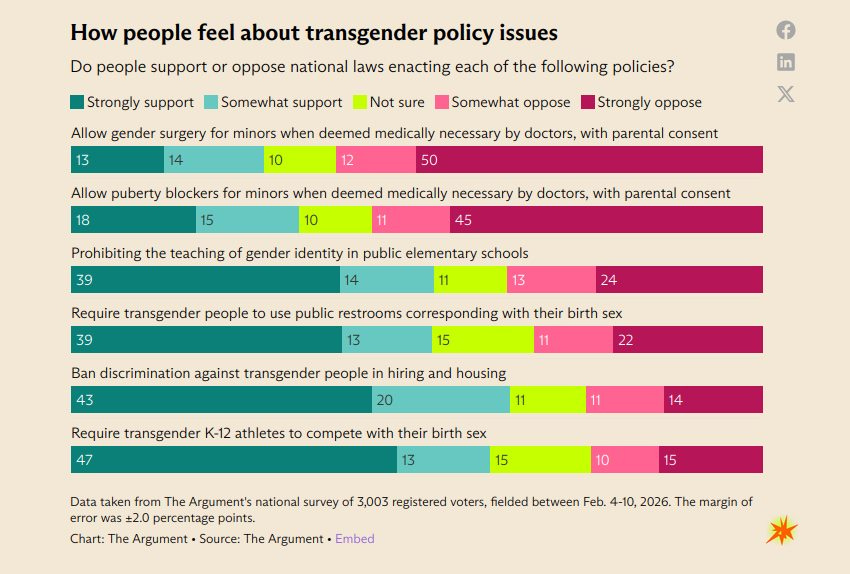
I’m using this recent survey chart as a snapshot. Polls don’t decide what’s right — but they do reveal where fear shows up, where empathy still exists, and where the public is persuadable. Take a moment to look at the results before you read further…
Start with what we agree on
There is one positive result in this survey: a strong majority supports banning discrimination against transgender people in hiring and housing.
That matters.
It means most people still believe in a basic principle: who you are should not cost you your livelihood or your home. So let’s take that seriously — not as a political talking point but as a moral anchor.
If you believe transgender people shouldn’t be denied a job or a place to live, you’re already saying something important: trans people are real people, worthy of protection in public life.
Now here’s the next question: what happens when policies about schools, bathrooms, and youth healthcare push in the opposite direction — not protecting someone’s ability to live, but restricting their ability to exist?
Why the “but” shows up
When I look at the chart, I don’t just see opinions. I see emotions and assumptions.
Topics like youth medical care trigger fear — because most people don’t know what that care actually looks like, how many safeguards already exist, or how rare some interventions are. People picture the most extreme version because that’s what the culture war feeds them.
Schools trigger fear because parents worry about losing influence over their children’s values.
Bathrooms trigger fear because privacy has been turned into a political weapon.
Sports trigger fear because fairness has long been a genuine concern — and also because the issue has been amplified far beyond the number of kids actually affected.
Here’s what I want to say clearly: your concerns are not automatically hate.
But — and this is important — the policies being sold as solutions can and do still cause real harm.
Good people can support harmful policies when fear is driving the conversation.
That doesn’t make you a villain. It makes you human. And it means you deserve better information than what cable news and campaign ads provide.
Let’s test for consistency
If you believe in fairness, I have to ask:
If discrimination is wrong in housing and employment, why is it acceptable in school life, where kids are forming their identity and sense of worth?
If privacy in bathrooms matters to you, why does the proposed “solution” so often require policing bodies, interrogating strangers, and putting children under suspicion?
If you genuinely want kids protected, why do you accept policies that isolate trans kids, increase stigma, and send the message: “You are a problem we must manage”?
Many of these laws aren’t neutral. They don’t just “set boundaries.” They create a permission structure for harassment — and they teach the public that trans people are suspicious by default.
What a bridge sounds like in real life
If you’re in the “yes, but…” majority, I’m not asking you to swallow a slogan.
I’m asking you to make three grounded commitments.
1) Protect people from discrimination. Consistently.
If you believe in fairness at work and housing, extend that same principle to schools and public life. A child’s dignity shouldn’t depend on whether adults are comfortable.
2) Don’t support legislating medicine through panic.
Youth healthcare is not a political talking point — it’s a relationship between families and qualified clinicians. You don’t have to understand every detail to believe that government should not replace medical expertise with campaign rhetoric.
3) Refuse policies that require policing and humiliation.
If a policy can only be enforced by surveilling bodies, accusing strangers, and putting children under suspicion, it is not a safety policy. It’s a social control policy.
That’s the bridge: fairness, competence, and humanity.
I’m inviting you into something better
You don’t have to “pick a side” in a culture war to pick a side for human beings. You can believe in fairness and care about children. You can value privacy and reject public humiliation. You can want thoughtful policies and refuse legislation built on fear.
And if you’re unsure — if you’re truly in that middle — I want you to know this:
Trans kids are not a theory. They’re not a threat. They are your neighbors, classmates, and family members. They are trying to grow up in a world that won’t stop debating whether they’re allowed to exist.
So start where we already agree: nobody should lose housing or a job for being who they are. Then let’s follow that principle all the way through. Because the opposite of “not discriminating” isn’t just tolerance. It’s dignity.
Fairness can’t stop at the door of a school, a bathroom, or a clinic. Either we believe in and pursue equal protection — or we don’t.
P.S. In the next essay, I’m going to focus on something that shapes this entire debate: language. The words used in polls, headlines, and legislation don’t just describe reality—they create it. And the framing is doing more work than most people realize.
This is VERY well written my friend!! I appreciate you! I miss you and wish we could work together again!
As a trans woman this hits hard. As someone who is related to many, many "yes buts" on both sides of the family it hits even harder.